Obol Splits
Obol develops and maintains a suite of smart contracts for use with Distributed Validators and their surrounding ecosystem of decentralized infrastructure. These contracts include:
- Validator Managers: Contracts used for a validator's withdrawal address, enabling ownership transfer, partial withdrawals, full exits, and operator rotation.
- Reward Splitting contracts: Contracts to split ether (and tokens) across multiple entities. Developed by Splits.org
Key Design Principles the Obol Smart Contract suite include are:
- That they are secure. All released Obol Splits products are audited by high quality security teams.
- They are not upgradeable.
- They are self-sovereign. Any permissioned actions, such as withdrawal, exit, or operator rotation, are controlled by the user, not an unaccountable set of third parties with the ability to upgrade your contract's behavior.
- They do not require a token to function.
- They are oracle-free. (Unless you intend to leverage a swapper).
- They divide the reward ether from principal ether such that staking providers can be paid a percentage of the reward they accrue for the principal provider rather than a percentage of principal and reward.
- That rewards can be withdrawn in an ongoing manner without exiting the validator. (Some conditions apply).
Obol Validator Managers
An Obol Validator Manager (OVM) is a smart contract which manages the deposit, withdrawal, exit, and public key rotation of one or more Ethereum validators. It is deployed as the withdrawal address for a validator and supports 0x01 and 0x02 validator types.
Creation
You create a new Validator Manager contract using the factory by calling the ObolValidatorManagerFactory.createObolValidatorManager() function, passing:
owner- The address that is the ultimate administrator of this Validator Manager deployment, it manages the assignment of roles for the contract, and can call all privileged methods. This address is best suited to being a multi-sig (such as a SAFE) with a large number of signers, used only as a fallback, or it can be owned temporarily, fine-grained roles can be assigned to addresses, and then therenounceOwnership()ortransferOwnership()methods can be called.beneficiary- This is the address where the principal will be returned to when validators exit or a withdrawal above theprincipalThresholdis made. This can be changed later by theowneror addresses with theSET_BENEFICIARY_ROLE.rewardRecipient- This is the address where the accrued ether reward will be sent whendistributeFunds()is called. Usually it is a Pull Split from splits.org. This can be changed later by theowneror addresses with theSET_REWARD_ROLE.principalThreshold- This is a configurable amount of Ether which dictates at what amount of value in the contract should we consider it to be principal being returned rather than reward accrued. The amount is immutable. A sensible default here is 16 ether (16000000000 gwei), the threshold used in Obol's earlier Optimistic Withdrawal Recipients. Further detail in the FAQ section.
Roles
Obol Validator Managers implement standard Role-Based Access Control. The OVM has the following roles that can be granted by the OVM owner, using the grantRoles() function.
DEPOSIT_ROLE: Permits an address to call thedeposit()function.CONSOLIDATION_ROLE: Permits an address to initiate a consolidation between one or more source validators and a target validator, all managed by this contract. All source and target validators must be active with a balance greater than 32 ether.WITHDRAWAL_ROLE: Permits an address to trigger a partial withdrawal, or full exit of all validators managed by this contract using EIP7002.SET_BENEFICIARY_ROLE: Permits an address to change the recipient of the principal returned when validators exit, or a withdrawal above the principalThreshold is initiated. Also this permits an address to adjust the amount of principal stake being tracked by the contract.SET_REWARD_ROLE: Permits an address to change the recipient of the reward whendistributeFunds()is called.RECOVER_FUNDS_ROLE: Permits an address to initiateERC20.transfer()calls to arbitrary external addresses, with the intent to recover otherwise stuck tokens.
Role Risks and Trust Assumptions
Granting a role extends trust to the address that holds it. The OVM is non-custodial and has no upgrade path or admin override beyond its owner, so a malicious or compromised role holder can act up to the limit of their role and nobody can stop them mid-transaction. Grant roles narrowly, prefer multi-sigs over externally owned accounts (EOAs) for any privileged address, and revoke roles you no longer need with revokeRoles(). A single address holding several roles, or whose key is later compromised, combines the risks below.
CONSOLIDATION_ROLE— can steal the entire stake. EIP-7251 does not require a consolidation's source and target validators to share withdrawal credentials; it only requires the target to be a compounding (0x02) validator. Theconsolidate()method does not restrict the target to validators managed by this contract, so a malicious holder can consolidate the OVM's validators into an external 0x02 validator that they control, moving all principal and reward balances out of the OVM's reach. This is the most dangerous role to grant.SET_BENEFICIARY_ROLE— can redirect returned principal. Setting the beneficiary to an attacker-controlled address sends all principal returned on the next exit, or above-threshold withdrawal, to that address. The same role can changeamountOfPrincipalStakeviasetAmountOfPrincipalStake(), distorting the principal-versus-reward accounting to misclassify funds in either direction.SET_REWARD_ROLE— can redirect accrued rewards. Setting the reward recipient to an attacker-controlled address sends all rewards to that address the next timedistributeFunds()is called, which anyone can do. In the misclassification edge cases of the optimistic accounting, this can also capture ether that was really principal.WITHDRAWAL_ROLE— cannot send funds to an external address, because withdrawals always return to the OVM, whose address is committed to in the validators' withdrawal credentials. It can, however, force-exit every validator, taking the cluster offline and locking funds in the exit queue for days. By choosing withdrawal amounts above or below theprincipalThreshold, a holder can also influence whether withdrawn ether is later treated as principal or reward (see the principal threshold FAQ), shifting value between the beneficiary and the reward recipient.RECOVER_FUNDS_ROLE— can drain any ERC20 token held by the contract to an arbitrary address. This does not touch the staked ETH, the principal, or the rewards, which are all native ETH rather than ERC20, but any tokens that arrive at the contract — airdrops, liquid staking tokens, or accidental transfers — can be taken.DEPOSIT_ROLE— can distort the principal accounting.deposit()does not validate the supplied withdrawal credentials, so a malicious holder can register validators whose credentials point outside the OVM, or whose signing keys they control. The depositor spends their own ether and cannot withdraw the contract's existing funds, but every deposit increasesamountOfPrincipalStake, so depositing to validators that never return their principal to the OVM inflates the principal accounting and skews the principal-versus-reward split. See the deposit warning in the Deposit section — only deposit to validators whose keys were generated by operators you trust.
The owner is the most powerful actor of all. The owner passes every permission check without holding any role, and additionally controls owner-only functions such as transfer() and the ownership handover flow. A malicious or compromised owner can therefore do everything listed above — steal principal and rewards, drain tokens, and force-exit validators. Treat the owner as the contract's master key: use a high-threshold multi-sig such as a SAFE, or assign fine-grained roles and then call renounceOwnership() so that no single key retains full control. Because the owner holds such significant control over the contract's funds, operators should only run validators for customers they trust.
Pointing the beneficiary or reward recipient at a contract address does not expose the OVM to re-entrancy theft. The fund-moving methods distributeFunds(), sweep(), withdraw(), and consolidate() are protected by a re-entrancy guard, and every method that sends ether updates its internal accounting before the transfer, so a malicious recipient cannot re-enter to claim the same funds twice. The only consideration is liveness: in push mode (distributeFunds()) the payout is atomic, so a recipient contract that rejects the transfer blocks that distribution until the recipient is changed. The pull path (distributeFundsPull() followed by withdrawPullBalance() or sweep()) is unaffected and lets each recipient claim independently.
Deposit
Every validator managed by an Obol Validator Manager must be deposited through the deposit() method. This method has the same signature as the official Ethereum deposit contract, but internally it accounts for the principal amount being deposited for the future calculation of returns of principal vs rewards. Only the owner address, or any address with the DEPOSIT_ROLE can call this method.
If a deposit was done directly to the official Ethereum deposit contract, the OVM will not have recorded the principal amount. To fix this, consider using setAmountOfPrincipalStake() to update the total principal amount of stake.
A validator's withdrawal credentials are fixed by the first deposit submitted for its public key. Every later deposit for that key is treated as a top-up, and its withdrawal credentials are ignored by the consensus layer. The deposit() method does not validate the withdrawal credentials it submits, and it cannot detect or prevent a deposit made directly to the Ethereum deposit contract for the same public key beforehand.
Creating a validator with a different withdrawal address requires its signing key, which for a Distributed Validator means a colluding threshold of its operators. Such operators could create the validator first, pointing its withdrawal address outside the OVM, so that the OVM's later deposit only tops up a validator whose principal exits beyond the contract's reach. No on-chain check can remove this property of the Ethereum deposit mechanism; it falls under the same trust assumption as the rest of the contract — only deposit to validators whose keys were generated by operators you trust.
Partial Withdrawals & Full Exits
Obol Validator Managers support EIP-7002 smart contract-based withdrawals. The owner address, or any address with the WITHDRAWAL_ROLE can call the withdraw() method to initiate a partial (or full) withdrawal of the balance of a validator managed by this contract.
If you request to withdraw an amount that would leave a validator with less than a 32 ETH balance, only the amount that would leave the validator with 32 ETH will be withdrawn.
If you request to partially withdraw a validator's balance, the funds will be available in the OVM contract at the end of the exit queue. (Usually ~27 hours)
However, if you withdraw the full balance of the validator, triggering its complete exit, the Ether will be available to the OVM contract once the validator is through the exit queue, and the skimming process has completed. (Average of ~5 days) This could add a number of days to the wait for validator funds, and full exiting at an optimal moment could significantly shorten the duration.
function withdraw(
    bytes[] calldata pubKeys,
    uint64[] calldata amounts,
    uint256 maxFeePerWithdrawal,
    address excessFeeRecipient
  ) external payable onlyOwnerOrRoles(WITHDRAWAL_ROLE) {}
  /// Emitted when a withdrawal request is submitted for a validator
  /// @param pubKey Validator public key
  /// @param amount Withdrawal amount in gwei
  /// @param fee Fee paid for the withdrawal
  event WithdrawalRequested(bytes pubKey, uint64 indexed amount, uint256 indexed fee);
Validator Consolidations
Obol Validator Managers support EIP-7251 smart contract-based validator consolidations. This is an important feature for rotating the private keys for the validators managed by this contract. The rotation of private keys allows for the secure re-distribution of validation duties among new operators, without a significant period of inactivity in a normal exit and recreate flow.
The owner address, or any address with the CONSOLIDATION_ROLE can call the consolidate() method, to initiate a consolidation between one or more source validators and a target validator, all managed by this contract.
All source and target validators must be active with a balance greater than 32 ether for the consolidation to succeed. The target validator must be an 0x02 type validator, 0x01 type validators can become 0x02 type through a self-consolidation, where the public key is the source and target.
It is possible to permissionlessly consolidate a validator into (or out of) an OVM. This could result in the OVM's amountOfPrincipalStake() not accurately reflecting the true amount of stake on validators exiting to the OVM withdrawal address. This could result in more (or less) ether being treated as reward, and disbursed to the rewardRecipient address. The owner of the OVM or any address with the SET_BENEFICIARY_ROLE can update the amount of Ether treated as principal with the setAmountOfPrincipalStake() function.
  struct ConsolidationRequest {
    bytes[] srcPubKeys;
    bytes targetPubKey;
  }

  function consolidate(
    ConsolidationRequest[] calldata requests,
    uint256 maxFeePerConsolidation,
    address excessFeeRecipient
  ) external payable onlyOwnerOrRoles(CONSOLIDATION_ROLE) {}
  /// Emitted when a consolidation request is submitted
  /// @param srcPubKey Source validator public key
  /// @param targetPubKey Target validator public key
  /// @param fee Fee paid for the consolidation
  event ConsolidationRequested(bytes srcPubKey, bytes targetPubKey, uint256 indexed fee);
Token Recovery
The owner address, or any address with the RECOVER_FUNDS_ROLE can call the recoverFunds() method, to send an ERC20 token balance on the ObolValidatorManager contract to an arbitrary recipient address.
Be cautious when interacting with unknown ERC20 addresses, they may not behave as anticipated.
  /// Recover non-OVM tokens to a recipient
  /// @param nonOVMToken Token to recover
  /// @param recipient Address to receive recovered token
  function recoverFunds(address nonOVMToken, address recipient) external onlyOwnerOrRoles(RECOVER_FUNDS_ROLE) {}
  /// Emitted after tokens are recovered to a recipient
  /// @param nonOVMToken Recovered token (cannot be ETH)
  /// @param recipient Address receiving recovered token
  /// @param amount Amount of recovered token
  event RecoverNonOVMFunds(address indexed nonOVMToken, address indexed recipient, uint256 amount);
Ownership Transfer
The owner address can call the transfer() method to hand over control of an Obol Validator Manager in a single transaction. It sets a new beneficiary (the address receiving returned principal) and transfers contract ownership to a new owner. This is useful when transferring or selling a validator position without exiting the underlying validators.
transfer() updates only the beneficiary and the owner. The contract does not enforce a reset of any other state, in particular:
- Previously granted roles are not revoked. Any addresses granted roles (such as
WITHDRAWAL_ROLEorSET_REWARD_ROLE) by the previous owner keep those roles after the transfer. The new owner should audit role assignments — usingrolesOf()for known addresses, or by reviewing the contract'sRolesUpdatedevent history — and callrevokeRoles()for any address that should no longer have access. - The reward recipient is not changed. Accrued rewards will continue to be sent to the existing
rewardRecipientaddress whendistributeFunds()is called. The new owner (or an address with theSET_REWARD_ROLE) should callsetRewardRecipient()if rewards should flow to a different address.
Optimistic Withdrawal Recipient
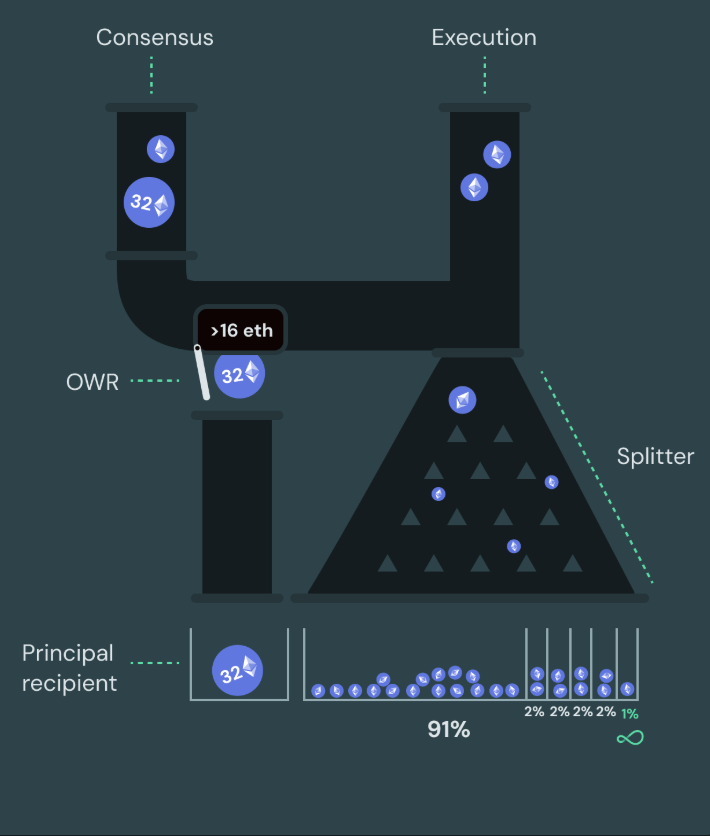
Optimistic Withdrawal Recipients (OWRs) are the predecessor to Obol Validator Managers. The primary addition with Validator Managers is the role-based control over validator withdrawals, exits and consolidations.
Optimistic Withdrawal Recipients allow for the separation of reward from principal, as well as permitting the ongoing withdrawal of accruing rewards.
An Optimistic Withdrawal Recipient contract takes three inputs when deployed:
- A principal address: The address that controls where the principal ether will be transferred post-exit.
- A reward address: The address where the accruing reward ether is transferred to.
- The amount of ether that makes up the principal.
This contract assumes that any ether that has appeared in its address since it was last able to do balance accounting is skimming reward from an ongoing validator (or number of validators) unless the change is > 16 ether. This means balance skimming is immediately claimable as reward, while an inflow of e.g. 31 ether is tracked as a return of principal (despite being slashed in this example).
Worst-case mass slashings can theoretically exceed 16 ether, if this were to occur, the returned principal would be misclassified as a reward, and distributed to the wrong address. This risk is the drawback that makes this contract variant 'optimistic'. If you intend to use this contract type, it is important you fully understand and accept this risk.
The alternative is to use a splits.org waterfall contract, which won't allow the claiming of rewards until all principal ether has been returned, meaning validators need to be exited for operators to claim their CL rewards.
This contract fits both design goals and can be used with thousands of validators. It is safe to deploy an Optimistic Withdrawal Recipient with a principal higher than you actually end up using, though you should process the accrued rewards before exiting a validator or the reward recipients will be short-changed as that balance may be counted as principal instead of reward the next time the contract is updated. If you activate more validators than you specified in your contract deployment, you will record too much ether as reward and will overpay your reward address with ether that was principal ether, not earned ether. Current iterations of this contract are not designed for editing the amount of principal set.
Split Contracts
Validators have two streams of revenue, the consensus layer rewards and the execution layer rewards. Validator Managers focus on the former, split contracts focus on the latter. They are best used in tandem.
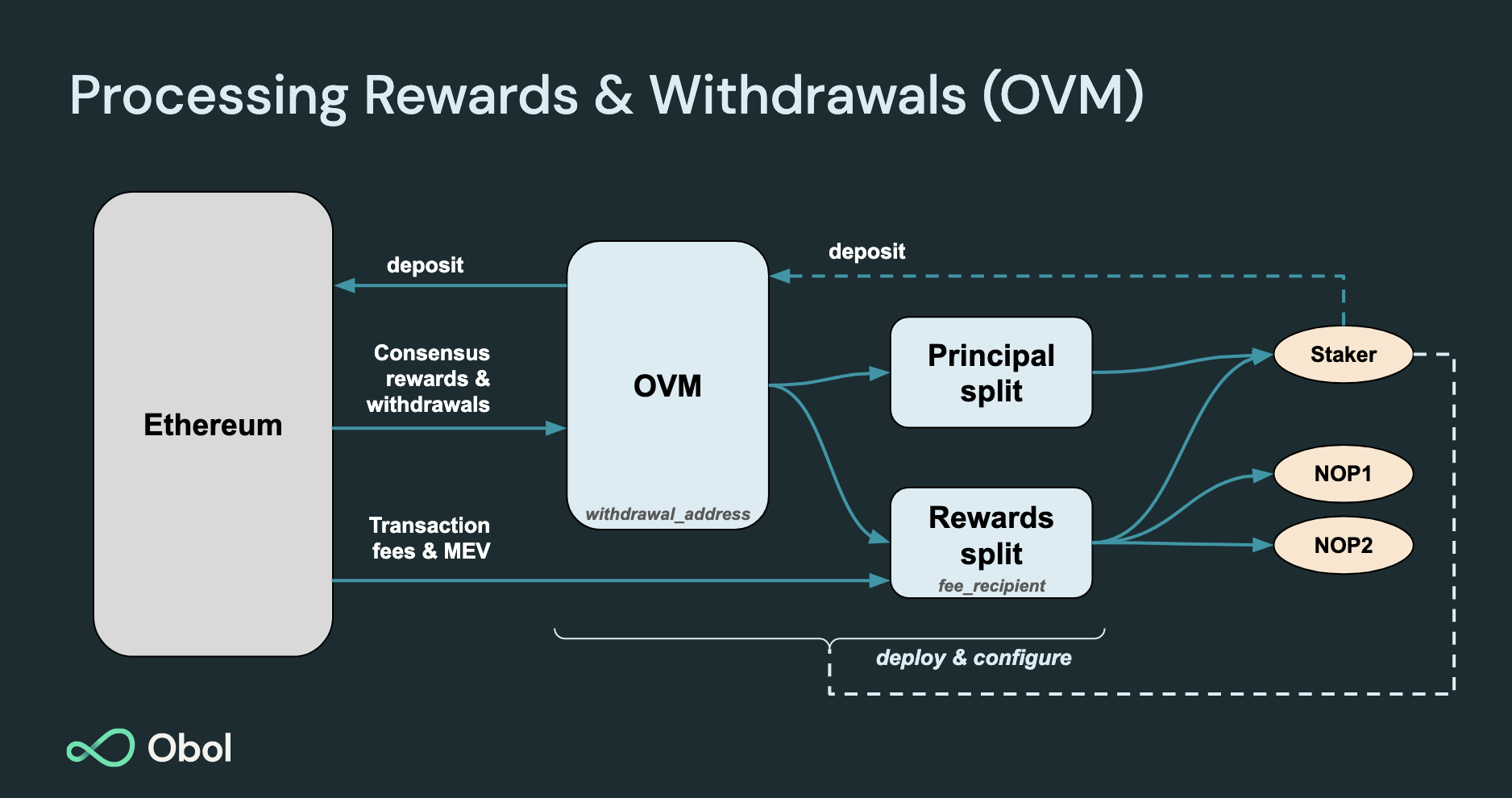
A split, or splitter, is a set of contracts that can divide ether or an ERC20 across a number of addresses. Splits are often used in conjunction with withdrawal recipients. Execution Layer rewards for a DV are directed to a split address through the use of a fee recipient address. Splits can be either immutable, or mutable by way of an admin address capable of updating them.
Further information about splits can be found on the splits.org team's docs site. The addresses of their deployments can be found here.
Split Controllers
Splits can be completely edited through the use of the controller address, however, total editability of a split is not always wanted. We recommend using a SAFE wallet to manage the Split.
(Gnosis) SAFE wallet
A SAFE is a common method to administer an editable split. The most well-known deployment of this pattern is the Protocol Guild. The SAFE can arbitrarily update the split to any set of addresses with any valid set of percentages.
Deployments
Obol Validator Manager Factory Deployment
The ObolValidatorManager contract is deployed via a factory contract. The factory is deployed at the following addresses on the following chains.
| Chain | Address |
|---|---|
| Mainnet | 0x2c26B5A373294CaccBd3DE817D9B7C6aea7De584 |
| Hoodi | 0x5754C8665B7e7BF15E83fCdF6d9636684B782b12 |
| Sepolia | 0xF32F8B563d8369d40C45D5d667C2B26937F2A3d3 |
Obol Lido Split Factory Deployment
The ObolLidoSplit contract is deployed via a factory contract. The factory is deployed at the following addresses on the following chains.
| Chain | Address |
|---|---|
| Mainnet | 0xa9d94139a310150ca1163b5e23f3e1dbb7d9e2a6 |
| Hoodi | 0xb633CD420aF83E8A5172e299104842b63dd97ab7 |
| Sepolia |
OWR Factory Deployment
The OptimisticWithdrawalRecipient contract is deployed via a factory contract. The factory is deployed at the following addresses on the following chains.
| Chain | Address |
|---|---|
| Mainnet | 0x119acd7844cbdd5fc09b1c6a4408f490c8f7f522 |
| Sepolia | 0xca78f8fda7ec13ae246e4d4cd38b9ce25a12e64a |
| Hoodi | 0x9ff0c649d0bf5fe7efa4d72e94bed7302ed5c8d7 |
FAQ
What are Obol Splits?
Obol Splits refers to a collection of composable smart contracts that enable the splitting of validator rewards and/or principal in a non-custodial, trust-minimized manner. Obol Splits contains integrations to enable DVs within Lido with Obol Lido Splits, and Native Staking with Obol Validator Managers.
Are Obol Splits non-custodial?
Yes. Unless you were to decide to deploy an editable splitter contract, Obol Splits are immutable, non-upgradeable, non-custodial, and oracle-free. Obol Validator Managers have owners and Role-Based Access Control, but these are self-sovereign and up to the deployer to set and manage. There is no third party with access to or control of your validators unless you grant them such access.
Obol Validator Managers
What happens if I deposit to an OVM managed validator directly with the Ethereum deposit contract instead of through the dedicated OVM.deposit() method?
In this case, the OVM contract will not have recorded the deposit as principal to be returned, so when the validator exits, it will be sent to the reward address. Consider editing the reward address to pay 100% to the principal recipient, exiting the validator, claiming the 'rewards', and editing the reward split back to normal, before depositing through the OVM for a new validator private key that exits to the same OVM contract.
What is the principal threshold for?
Determining if Ether returned from a validator is principal deposited or rewards accrued is difficult. Rather than introducing an off-chain proof system, or trusted oracle, Obol Splits adopt an assumption that a mass slashing so severe that the principal returned is less than 16 eth is very rare, and the outcome that would happen in that case is the rewards would be sent to the reward rather than principal address, an accepted risk. This however does impact reward claiming on very large 0x02 validators. A validator could have earned 20 ether in rewards, and if a request for withdrawal of 20 ether is processed, it would be subtracted from principal and disbursed to the principal recipient, and upon a full exit, the remaining eth beyond the principal would be sent to the rewards address. To avoid this, entities with the WITHDRAWAL_ROLE should withdraw increments less than the principalThreshold if they want it treated as reward, and more than principalThreshold if they want to process it as a direct exit.
What should I check after receiving an OVM through the transfer() method?
The transfer() method changes only the owner and the beneficiary, so the contract may still carry configuration from the previous owner. Before relying on the contract, verify that no unexpected addresses hold roles (check rolesOf() for known addresses, or review the contract's RolesUpdated event history) and revoke any with revokeRoles(). Also check the rewardRecipient address, as it is not changed by the transfer, and update it with setRewardRecipient() if needed. See Ownership Transfer for details.
Can I change the percentages in a split?
Generally Obol Splits are deployed in an immutable fashion, meaning you cannot edit the percentages after deployment. However, if you were to choose to deploy a controllable splitter contract when creating your Split, then yes, the address you select as controller can update the split percentages arbitrarily. A common pattern for this use case is to use a Gnosis SAFE as the controller address for the split, giving a group of entities (usually the operators and principal provider) the ability to update the percentages if need be. A well-known example of this pattern is the Protocol Guild.
Are Obol Splits open source?
Yes, Obol Splits are licensed under GPLv3 and the source code is available here.
Are Obol Splits audited?
The Obol Splits contracts have been audited, though further development has continued on the contracts since. Consult the audit results here and always deploy contracts only from published releases.
Are the Obol Splits contracts verified on Etherscan?
Yes, you can view the verified contracts on Etherscan. A list of the contract deployments can be found here.
Does my cold wallet have to call the Obol Splits contracts?
No. Any address can trigger the contracts to distribute the withdrawn/skimmed ether, they do not need to be a member of the Split either. You can set your cold wallet/custodian address as the recipient of the principal and rewards, and use any hot wallet to pay the gas fees to push the ether into the recipient address.
Are there any edge cases I should be aware of when using Obol Splits?
The most important thing to be aware of is what address is the owner of the Obol Validator Manager, whether it has assigned any other addresses any roles, and whether or not the Split contract you are using has been set up with editability and by which address. If a splitter is editable, you should understand what the address that can edit the split does. Is the editor an EOA? Who controls that address? How secure is their seed phrase? Is it a smart contract? What can that contract do? Can the controller contract be upgraded? etc. Generally, the safest thing in Obol's perspective is to use a high threshold multi-sign like a SAFE as the owner/controller, or to renounce ownership and control entirely, and if in the future you are unhappy with the configuration, that you exit the validator and create a fresh cluster with new settings that fit your needs.
Another aspect to be aware of is how the splitting of principal from rewards works using the Optimistic Withdrawal Recipient contract. There are edge cases relating to not calling the contracts periodically or ahead of a withdrawal, activating more validators than the contract was configured for, and a worst-case mass slashing on the network. Consult the documentation on the contract here, its audit here, and follow up with the core team if you have further questions.